
GPC Builds High-Quality Industrial Chain via Coupled Circular Economy
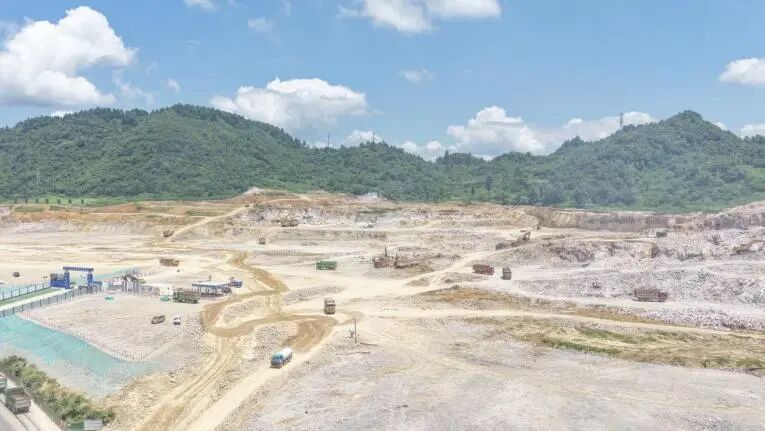
In early October at Shuangyong Village, Shuangliu Town, Kaiyang County, site leveling work for Phase I of the Kaiyang Phosphorus-Titanium-Iron-Lithium Coupled Integrated Circular Project, with a total investment of 33.1 billion yuan, is drawing to a close. The project is poised to enter an accelerated phase of main construction.
The project boasts a large scale: it includes facilities for 1.4 million tonnes of ferrous sulfate heptahydrate co-produced with 400,000 tonnes of titanium dioxide, 600,000 tonnes of lithium iron phosphate, and 20,000 tonnes of lithium hexafluorophosphate. More noteworthy than its scale, however, is its internal circular system for the on-site consumption of by-products.
Phosphogypsum, a by-product of wet-process phosphoric acid production, will be decomposed to produce sulfuric acid and fed back into phosphoric acid manufacturing. Ferrous sulfate generated as a by-product from titanium dioxide production will no longer be sold externally as a low-value commodity; instead, it will serve directly as feedstock for lithium iron phosphate. Fluorine, accounting for only around 3% of phosphate ore, is recovered using proprietary GPC technologies and further processed into lithium hexafluorophosphate, a core electrolyte material for lithium batteries.
By-products from one production line become raw materials for another. This coupled model establishes an internal circular loop between resource inputs and product outputs, breaking away from the conventional linear “raw materials in, finished goods out” manufacturing approach.
According to GPC officials, the project represents a systematic exploration of full-resource exploitation, full-chain circulation and all-factor innovation. It aims to create a closed-loop system featuring cascaded resource utilization and internal by-product absorption. “Once fully completed, the project will grow into one of Southwest China’s largest production bases for phosphorus-based cathode materials.”
Site leveling marks an important engineering milestone. More fundamentally, the project seeks to address a core challenge: how to ensure every element within the phosphorus‑titanium‑lithium‑fluorine resource portfolio finds its next destination inside the industrial chain. During the main construction phase, this closed-loop design will be translated from blueprints into physical production facilities.


